Arbitrage betting explained: how it works, whether it's worth it, and the real risks
Last updated: April 2026
Arbitrage betting — or "arbing" — means backing every possible outcome of an event across different bookmakers at odds that guarantee a profit regardless of the result. It's mathematically risk-free, completely legal, and one of the only ways to extract guaranteed money from the betting market. It's also harder than it sounds, and bookmakers actively work to stop you doing it. This guide explains how arbitrage works, walks through a real example, and covers the practical challenges most guides leave out.
How arbitrage betting works
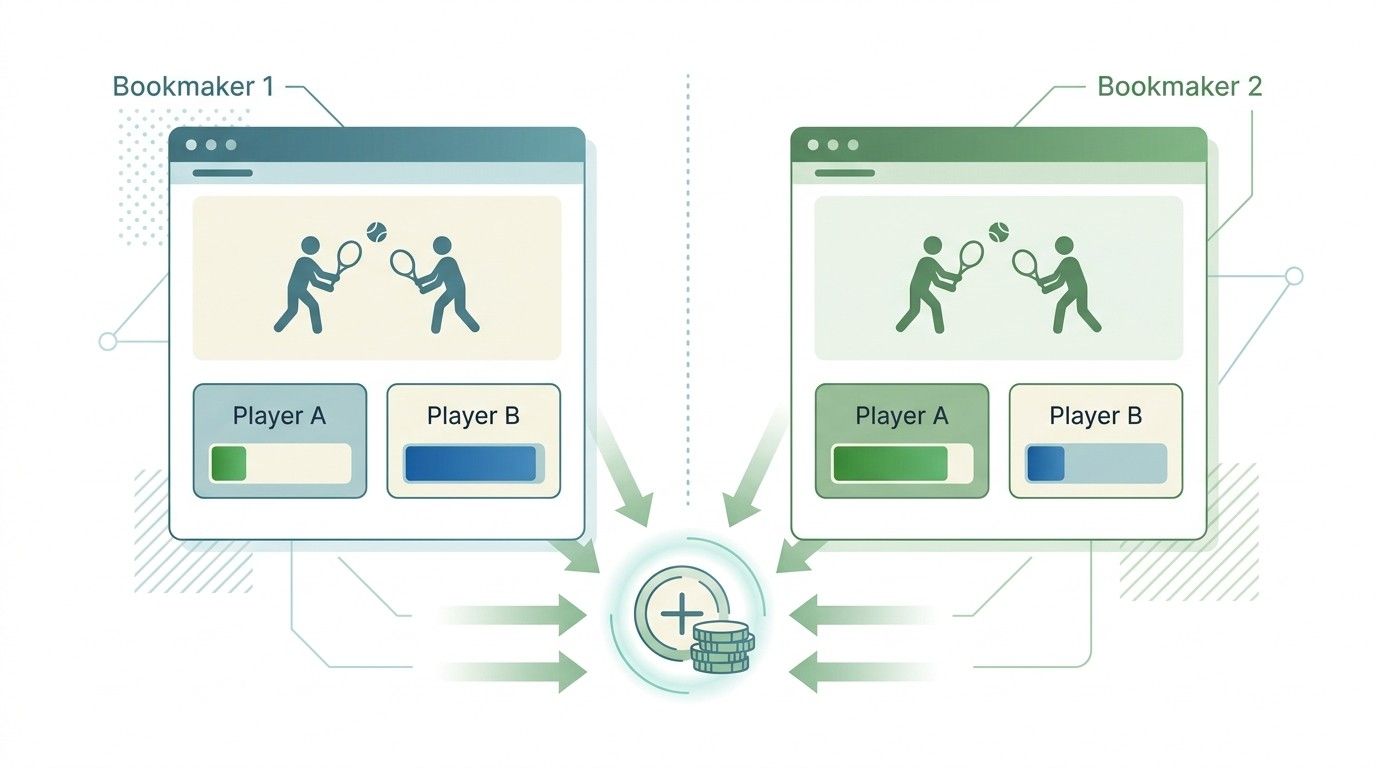
Arbitrage opportunities arise when different bookmakers disagree on the odds enough that backing every outcome produces a guaranteed profit. This happens because bookmakers set odds independently, and price differences — especially on less popular markets — create temporary windows where the combined implied probability of all outcomes drops below 100%.
The 100% rule
On any event with defined outcomes, the implied probabilities should add up to more than 100% — the excess is the bookmaker's margin. For example, a football match at one bookmaker:
| Outcome | Odds (decimal) | Implied Probability |
|---|---|---|
| Home win | 2.50 | 40.0% |
| Draw | 3.40 | 29.4% |
| Away win | 3.00 | 33.3% |
| Total | — | 102.7% |
The 2.7% over 100% is the bookmaker's margin — no arb here.
But if you shop across bookmakers and find the best odds for each outcome:
| Outcome | Best Odds | Bookmaker | Implied Probability |
|---|---|---|---|
| Home win | 2.70 | Bookmaker A | 37.0% |
| Draw | 3.80 | Bookmaker B | 26.3% |
| Away win | 3.50 | Bookmaker C | 28.6% |
| Total | — | — | 91.9% |
91.9% is below 100% — an arbitrage opportunity exists. The gap (8.1%) is your guaranteed profit margin before staking.
Our arbitrage calculator does this maths instantly — enter the odds for each outcome and it tells you whether an arb exists and how to split your stake.
Worked example
You find an arb on a tennis match:
| Outcome | Odds | Bookmaker |
|---|---|---|
| Player A wins | 2.20 | Bookmaker X |
| Player B wins | 2.10 | Bookmaker Y |
Combined implied probability: (1/2.20) + (1/2.10) = 0.4545 + 0.4762 = 0.9307 = 93.07%
This is below 100%, so an arb exists.
Stake calculation (for a £100 total stake):
- Stake on Player A = £100 × (1/2.20) / 0.9307 = £48.82
- Stake on Player B = £100 × (1/2.10) / 0.9307 = £51.18
Returns:
- If Player A wins: £48.82 × 2.20 = £107.40. Profit: £7.40
- If Player B wins: £51.18 × 2.10 = £107.48. Profit: £7.48
Either way, you profit approximately £7.44 on a £100 total stake — a 7.44% return with zero risk.
Where to find arbitrage opportunities
Dedicated arb software
Tools like OddsJam, RebelBetting, and BetBurger scan hundreds of bookmakers in real time and alert you when arbs appear. They calculate stakes automatically and some integrate directly with bookmaker accounts. Most charge a monthly subscription (£30–£100+).
Betting exchanges
Betting exchanges like Betfair allow you to "lay" outcomes (bet against them). Combining a back bet at a bookmaker with a lay bet on an exchange is one of the most common arbing methods — often called "matched betting" when done with free bet promotions.
Where arbs appear most often
- Less popular sports and leagues (lower liquidity = wider price differences)
- In-play markets (odds move fast and bookmakers don't always align)
- New markets just after they open
- Events with many outcomes (golf, horse racing)
Typical arb margins
| Scenario | Typical Margin |
|---|---|
| Major football — match result | 0.5–2% |
| Tennis — match winner | 1–3% |
| Minor leagues / niche sports | 2–5% |
| In-play markets | 1–4% (higher risk of odds changing) |
| Cross-bookmaker vs exchange | 1–3% |
Margins are small. A £100 stake producing £1–£3 profit is typical. Arbing is profitable through volume and consistency, not individual bets. Most serious arbers process dozens of bets per day.
The risks — what most guides don't tell you
Account restrictions
This is the biggest practical problem. Bookmakers monitor betting patterns and restrict or close accounts that consistently arb. Signs they look for: betting on both sides of the same market, consistently taking the best available price, never using promotions or accumulators, and withdrawing frequently.
Once restricted, your maximum stake is reduced — sometimes to as low as £1 — making the account effectively useless for arbing. Some bookmakers close accounts entirely.
Odds movement
Arb windows are short. Between identifying an arb and placing both bets, the odds can change. If you place one side and the odds move before you place the other, you're exposed — one winning bet and one losing bet, with no guarantee of profit. This is called a "middle" and it's the main execution risk.
Palpable errors
Bookmakers reserve the right to void bets placed on "palpable errors" — obviously incorrect odds. If one side of your arb is voided, you're left with the other side as a naked bet. Read the terms and conditions.
Staking limits
Different bookmakers have different maximum stakes, especially on less popular markets. Your calculated optimal stake may exceed what one bookmaker allows, reducing or eliminating the arb.
Arbitrage vs dutching
Arbitrage and dutching are related but different:
| Arbitrage | Dutching | |
|---|---|---|
| Bookmakers used | Multiple (different odds from different bookmakers) | One bookmaker |
| Guaranteed profit? | Yes (if combined probability < 100%) | Only if one bookmaker's odds are generous enough |
| Account risk | High — bookmakers restrict arbers | Low — all bets at one bookmaker |
| Typical margins | 1–3% | 0–2% (harder to find) |
Our dutching calculator handles the single-bookmaker version. The arbitrage calculator handles the cross-bookmaker version.
Is arbitrage betting worth it?
The maths says yes
Risk-free profit is risk-free profit. Even at 1–2% per bet, processing 20 bets per day at £100 each produces £20–£40/day — tax-free in the UK since gambling winnings aren't taxed.
The practice says "it depends"
The operational challenges are real: you need accounts at 10–20+ bookmakers, you need starting capital spread across all of them, you need speed (arb windows close fast), you need arb-finding software, and you need to accept that your accounts will eventually be restricted.
Most people who try arbing find that the initial months are profitable, but account restrictions gradually reduce the available opportunities until it's no longer worth the time. Professional arbers counter this by constantly opening new accounts, using multiple identities (which is against bookmaker terms), or shifting to exchange-based strategies.
Our view
Arbitrage is mathematically sound and worth understanding. Whether it's worth pursuing as a sustained activity depends on your risk tolerance for account restrictions, your available capital, and how much time you're willing to invest. For understanding how bookmaker margins work and how odds and probability relate to value, the concept is genuinely educational — even if you never place an arb.
Frequently asked questions

Written by
David Burke
David is a gambling industry analyst and poker player based between London, Spain, and Malta. He has spent over a decade observing the European betting and casino landscape, with particular expertise in odds, probability, game strategy, and how the bookmaking industry works. At WiseStaker, David writes guides on bet types, game rules, and the mathematics behind gambling.
Follow on X →