5 Numbers Every UK Gambler Should Check Before Their Next Bet
6 April 2026
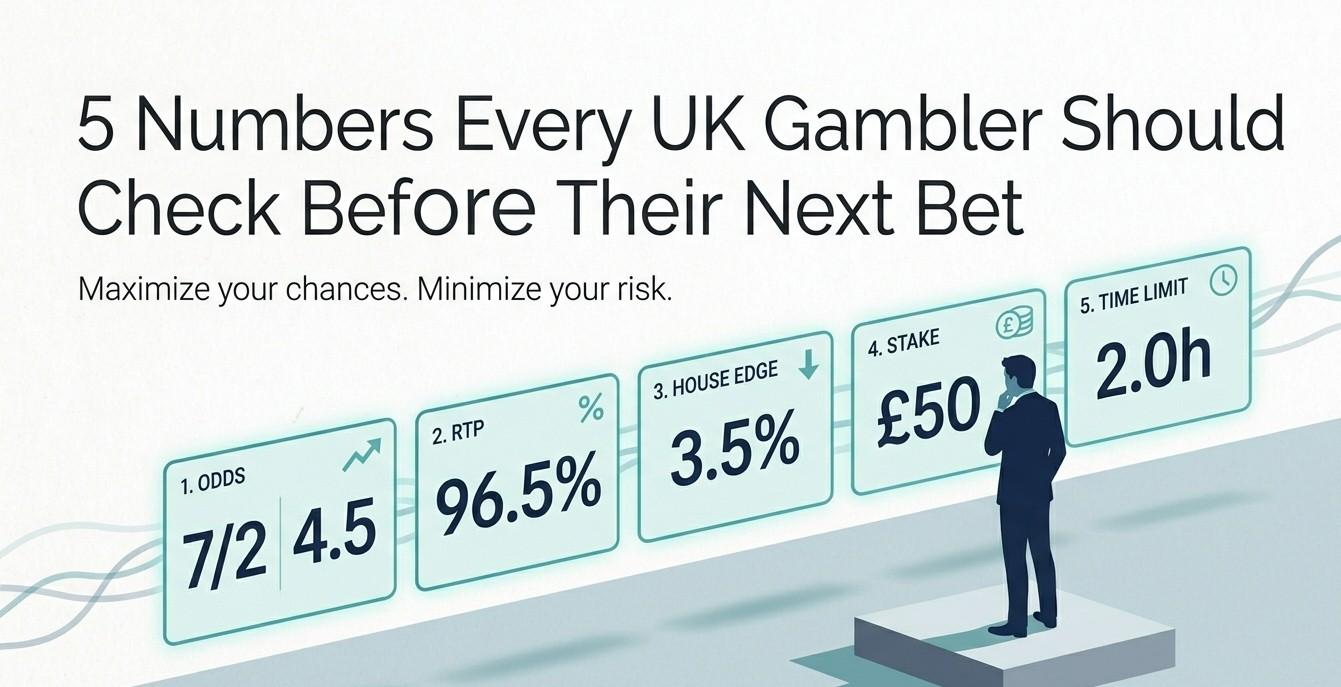
Most people who gamble have never looked at the numbers that determine whether they win or lose — not the odds on their bet slip, but the numbers behind the scenes. The RTP of the slot they're playing. The bookmaker's margin on the market they're betting on. How much they've actually spent this month.
These five numbers take about five minutes to check. Together, they give you a clearer picture of your gambling than years of hunches ever could.
The RTP of your slot
Every online slot has a Return to Player percentage — the proportion of money wagered that's returned as prizes over time. A 96% RTP slot keeps 4p of every £1 you wager. A 92% RTP slot keeps 8p — double the cost for the same entertainment.
The range is enormous. The best slots return 98–99%. The worst — often branded tie-ins and progressive jackpot games — can be as low as 85%. That's 15p lost per £1 wagered.
How to check: open the game's info or paytable section (look for an "i" or "?" icon). The RTP should be listed there. If it's not, check the casino's game information page — UKGC-licensed operators are required to make it available.
The rule: if the RTP is below 94%, you're paying a premium for that game. For a full breakdown of what RTP means and how volatility affects your experience, see our RTP explained guide.
Your actual monthly gambling spend
Ask yourself: how much did you spend on gambling last month? Now check your bank statement. For most people, there's a gap — and the real number is higher than the guess.
This isn't about judgment. Plenty of people spend £50 a month on gambling and consider it entertainment, just like a Netflix subscription or a night out. The problem is when you don't know the number — because spending you're not tracking is spending you're not controlling.
How to check: search your bank statements for deposits to gambling sites. Add them up. Don't subtract winnings — you want the gross spend, because that's the money that left your account.
The rule: if the number surprises you, that's exactly why this check matters. Our cost of gambling calculator projects your spend over weeks, months, and years — and shows you what it's equivalent to in other terms.
The bookmaker's margin on your bet
When you bet on a football match, the odds aren't fair. They include the bookmaker's margin — the gap between the true probability and the odds offered. A typical Premier League match has a margin of 4–6%. A niche lower-league market might be 8–10%.
This margin is the invisible cost of every bet. Even if your selection wins, you were paid less than the true odds justified. Over hundreds of bets, that margin compounds into a meaningful drain on your bankroll.
How to check: add up the implied probabilities of all outcomes in a market. If they total 104%, the bookmaker's margin is 4%. Our betting odds explained guide shows you exactly how to do this calculation.
The rule: the higher the margin, the worse the value. Betting exchanges typically operate at 2–3% margin versus 5–10% at traditional bookmakers. If value matters to you, the platform matters.
Your PGSI score
The Problem Gambling Severity Index is a 9-question screening tool used by the UK Gambling Commission, the NHS, and treatment providers worldwide. It asks about behaviours like chasing losses, betting beyond your means, and feeling guilty about gambling. Each answer is scored 0–3, giving a total between 0 and 27.
Most people who gamble have never taken it. Many people who should take it assume it's not for them — "I'm not a problem gambler, I just have the occasional bet." The PGSI isn't only for people in crisis. It's for anyone who wants to understand where they sit on the risk spectrum.
How to check: our PGSI self-assessment takes two minutes. It's confidential — nothing is stored, sent, or shared. You answer 9 questions and get an immediate result.
The rule: a score of 0 means no risk. 1–2 is low risk. 3–7 is moderate risk. 8+ is problem gambling. If you score 3 or above, it's worth paying attention — not panicking, but paying attention.
Your deposit limit
Every UKGC-licensed gambling operator must let you set daily, weekly, or monthly deposit limits. Since 2025, operators must prompt new customers to set a limit before their first deposit.
But many existing customers have never set one — or set a limit so high it's meaningless. A £5,000 monthly deposit limit on a £2,500 salary isn't a limit. It's decoration.
How to check: log into your gambling accounts and look under "Responsible Gambling," "Safer Gambling," or "Account Settings." Check what your current limit is. If there isn't one, set one now. If there is one, ask yourself whether it's realistic.
The rule: your deposit limit should reflect what you can genuinely afford to lose — not what you'd like to be able to afford. Set it while you're calm, not during a session. Once set, it can't be increased without a cooling-off period, which is exactly the point.
For a structured approach to setting a gambling budget based on your actual income and expenses, our bankroll calculator works through the maths with you.
Five minutes, five numbers
None of these checks require signing up for anything, paying for anything, or admitting anything to anyone. They're just numbers — but they're the numbers that separate informed gambling from blind gambling.
The house edge doesn't change because you checked it. The bookmaker's margin doesn't shrink because you calculated it. But your decisions might — and that's the point.

Written by
David Burke
David is a gambling industry analyst and poker player based between London, Spain, and Malta. He has spent over a decade observing the European betting and casino landscape, with particular expertise in odds, probability, game strategy, and how the bookmaking industry works. At WiseStaker, David writes guides on bet types, game rules, and the mathematics behind gambling.
Follow on X →