The Sunk Cost Trap: Why Gamblers Chase Losses (And How to Stop)
6 April 2026
You've lost £50 in the first half hour. The rational move is to stop. But instead, you increase your bet. Not because the odds have improved — they haven't — but because walking away now means accepting that £50 is gone.
So you keep playing. The £50 becomes £150.
That impulse has a name: the sunk cost fallacy. And it's the single most expensive thinking error in gambling.
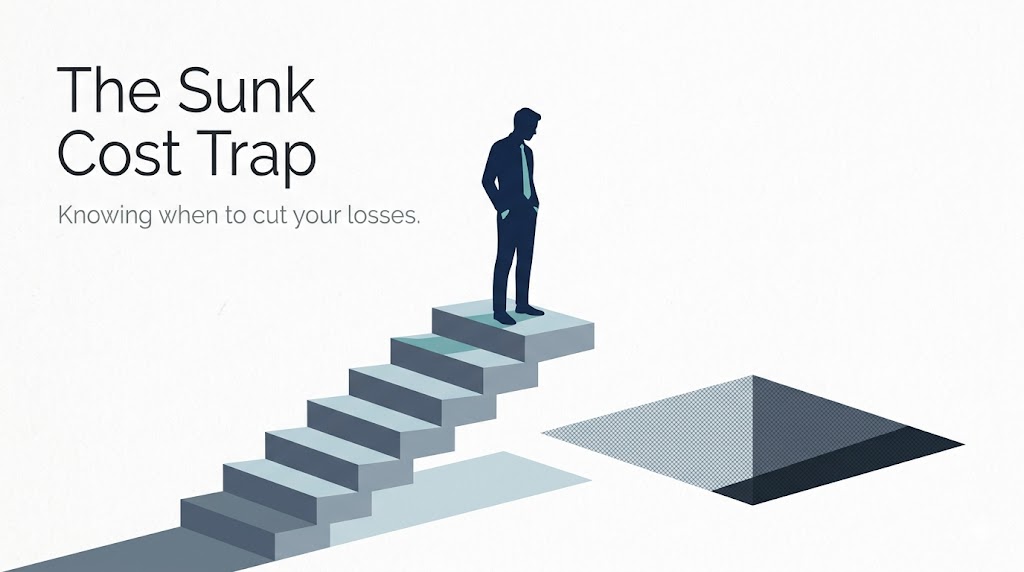
What's actually happening in your head
The sunk cost fallacy is the tendency to keep doing something because you've already invested money, time, or effort — even when continuing will cost you more than stopping.
The logic is simple: the £50 is gone whether you play another hand or walk out the door. The only question that matters is whether the next bet has positive expected value. In almost every casino game, it doesn't. The house edge is the same on every spin, every hand, every roll — regardless of what happened before. Our odds calculator shows you the actual probability of any bet — a number that doesn't shift based on your streak.
But that's the logic. The feeling is different. Stopping feels like confirming the loss. Continuing feels like preserving the possibility of recovery. Your brain is wired to avoid definite losses, even when the alternative is a probable bigger loss.
This is why chasing losses is so common and so destructive. It's not stupidity — it's human psychology working against you in an environment specifically designed to exploit it.
The pattern is always the same
Sunk cost thinking doesn't just happen in gambling. But gambling is where it does the most financial damage, the fastest.
| Situation | Sunk cost thinking | Rational thinking |
|---|---|---|
| Lost £100 gambling tonight | "I need to win it back" | "The £100 is gone. Will another hour most likely lose me more?" |
| Paid £15 for a bad film | "I should stay, I've already paid" | "The £15 is spent either way. Do I want to waste 90 more minutes?" |
| Held a losing stock for 6 months | "I can't sell now — I'd lock in the loss" | "Would I buy this stock today at this price?" |
| Waited 40 minutes for a bus | "I've already waited this long" | "Is a taxi faster from here?" |
The pattern: sunk cost thinking always looks backward at what's been spent. Rational thinking always looks forward at what happens next.
In gambling, this loop is uniquely dangerous because decisions happen in seconds, each new loss raises the emotional stakes of stopping, and occasional wins reset the hope cycle just enough to keep you going.
Why gambling makes it worse
Three features of gambling supercharge the sunk cost fallacy:
Speed
A roulette spin takes 30 seconds. A slot spin takes 3. There's no time to step back and think rationally between bets.
Near-misses
Landing two out of three matching symbols feels like progress. It's not — it's statistically meaningless. But it creates the illusion of being close, making the next bet feel more justified.
Variable reinforcement
Occasional small wins interrupt the losses. A £10 win in the middle of a £100 losing session resets the emotional clock and makes you feel like a turnaround is starting. It isn't — but it feels that way.
This combination is why people can lose far more than they intended in a single session. It's not a lack of willpower. It's a cognitive bias operating in the one environment most perfectly designed to exploit it. Our cost of gambling calculator can show you exactly how quickly these losses compound over weeks and months.
How to break the loop
Set your limit before you start
Decide your maximum loss while you're calm — not mid-session. Write it down or set it as a deposit limit with your operator. When you hit it, stop. No negotiation.
Use the "would I start now?" test
At any point, ask: "If I hadn't played tonight, would I sit down right now and start with the amount I have left?" If the answer is no, you're only continuing because of what you've already lost.
Track in real numbers
Chasing thrives on vague feelings. "I'm not that far down" is easy to believe when you're not counting. Write down your starting balance and check it before every "just one more" decision. When the number is staring back at you, the sunk cost fallacy loses much of its power.
Know the maths
The odds don't change because you're losing. The house edge on the next bet is identical to the last one. Checking the actual probability before betting — not after losing — is the habit that breaks the chase.
The bigger picture
Chasing losses isn't a character flaw — it's a predictable consequence of how human brains process loss. Behavioural economists Daniel Kahneman and Amos Tversky demonstrated that we feel losses roughly twice as intensely as equivalent gains. That asymmetry is the engine behind every chasing episode.
If you recognise this pattern in your own gambling, you're already ahead — because recognition is what breaks the loop. For a deeper dive into the psychology, our full article on the sunk cost fallacy covers the research, the famous Monte Carlo Casino example, and the connection to the gambler's fallacy.
And if you're wondering whether the pattern has gone beyond occasional frustration into something more serious, our self-assessment quiz is confidential, takes two minutes, and might be worth the time.
Written by
Ciaran McEneaney
Ciaran is a gambling industry writer based in Ireland with over a decade of experience covering the regulated betting sector. He specialises in gambling regulation, industry statistics, player protection, and responsible gambling policy. At WiseStaker, Ciaran covers UK and international gambling data, support resources, and the psychology behind gambling behaviour.
Follow on X →