How to play baccarat: rules, card values, odds, and strategy
Last updated: April 2026
Baccarat is one of the most popular casino card games in the world — and one of the simplest. You bet on whether the Player hand or the Banker hand will get closer to 9. That's it. There are no decisions to make once the cards are dealt, no strategy charts to memorise, and the house edge on the Banker bet (1.06%) is among the lowest in any casino. This guide covers how baccarat works, the card values, the drawing rules, and why the Banker bet is almost always the smartest choice.
How baccarat works
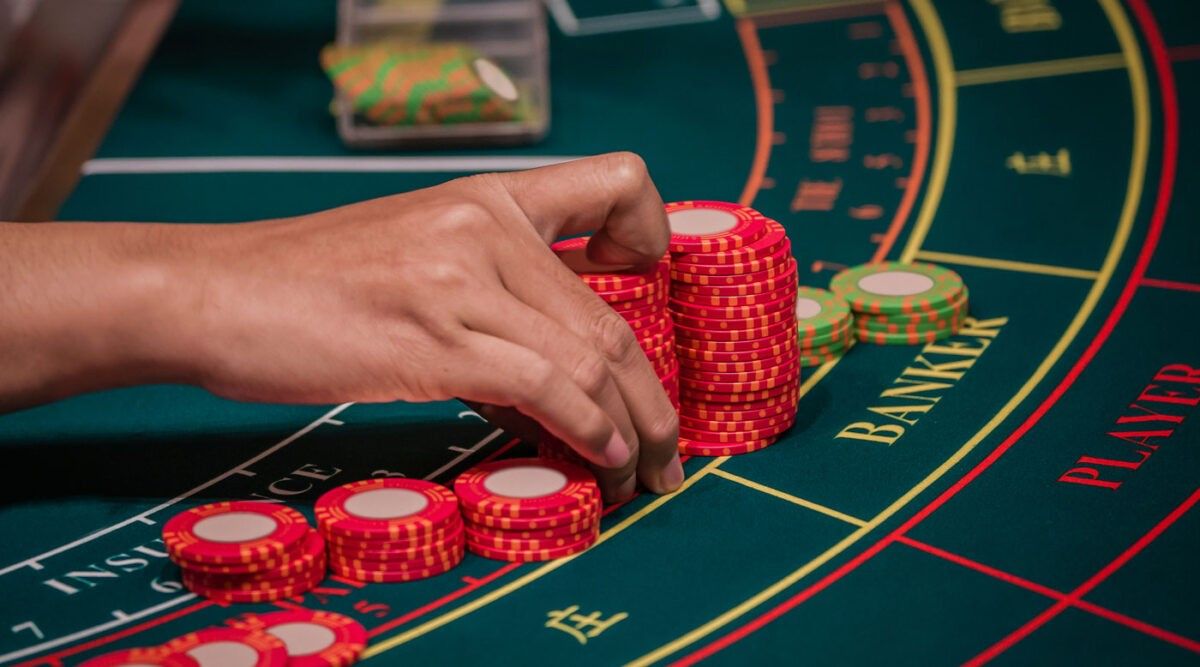
Baccarat is played between two hands: the Player and the Banker. These are just names — they don't refer to you or the dealer. You bet on which hand will win, or whether they'll tie.
Each hand receives two cards. Depending on the total, a third card may be drawn according to fixed rules. You don't choose — the rules determine everything automatically. The hand closest to 9 wins.
Card values
| Card | Value |
|---|---|
| 2–9 | Face value |
| 10, Jack, Queen, King | 0 |
| Ace | 1 |
The key difference from blackjack: face cards are worth zero, and you only use the last digit of any total. A hand of 7 + 8 = 15, but in baccarat that's 5 (drop the tens digit). A hand of 4 + 6 = 10, which becomes 0 (the worst possible hand).
This means no hand can bust — the highest possible value is 9 (a "natural"), and the lowest is 0.
Step-by-step: how a hand plays out
- Place your bet: Player, Banker, or Tie.
- Two cards each: Both Player and Banker receive two cards face up.
- Check for naturals: If either hand totals 8 or 9, no more cards are drawn. This is a "natural" and the higher hand wins (or it's a tie).
- Player drawing rule: If the Player total is 0–5, the Player draws a third card. If 6–7, the Player stands.
- Banker drawing rule: The Banker's decision depends on their own total AND the Player's third card (see drawing rules table below).
- Compare hands: The hand closer to 9 wins. If both are equal, it's a tie.
Third card drawing rules
The Player rule is simple: draw on 0–5, stand on 6–7.
The Banker rule is more complex — it depends on the Banker's current total and the value of the Player's third card:
| Banker Total | Draws When Player's Third Card Is | Stands When |
|---|---|---|
| 0–2 | Always draws | — |
| 3 | 0–7, 9 | 8 |
| 4 | 2–7 | 0, 1, 8, 9 |
| 5 | 4–7 | 0–3, 8, 9 |
| 6 | 6–7 | 0–5, 8, 9 |
| 7 | — | Always stands |
You don't need to memorise this table — the dealer (or software) handles it automatically. But understanding it explains why the Banker hand wins slightly more often: the Banker gets to act second and the drawing rules are optimised in the Banker's favour.
The three bets
| Bet | Payout | House Edge | Probability of Winning |
|---|---|---|---|
| Banker | 0.95:1 (5% commission) | 1.06% | 45.87% |
| Player | 1:1 | 1.24% | 44.63% |
| Tie | 8:1 (sometimes 9:1) | 14.36% | 9.51% |
Banker bet
The Banker hand wins 45.87% of the time (excluding ties) — slightly more often than the Player due to the asymmetric drawing rules. To offset this, the casino takes a 5% commission on Banker wins. Even after commission, the Banker bet has a 1.06% house edge — one of the best bets in any casino game. For comparison, see how this stacks up in our house edge explained guide.
Player bet
The Player bet pays 1:1 with no commission, but the Player hand wins less often (44.63%). The house edge is 1.24% — slightly worse than Banker but still excellent by casino standards.
Tie bet
The Tie bet is one of the worst bets in the casino. It pays 8:1 (or 9:1 at some tables), but ties occur only 9.51% of the time. The house edge is 14.36% at 8:1 payout. That's worse than most slot machines. Avoid it entirely.
Baccarat odds and probabilities
| Outcome | Probability | House Edge | Expected Loss per £100 Wagered |
|---|---|---|---|
| Banker wins | 45.87% | 1.06% | £1.06 |
| Player wins | 44.63% | 1.24% | £1.24 |
| Tie | 9.51% | 14.36% | £14.36 |
These numbers make baccarat one of the best-value games in the casino. The Banker bet at 1.06% is beaten only by blackjack with basic strategy (0.5%) and video poker with optimal play (0.46%). If you want to see how much any house edge costs over time, our house edge calculator breaks it down per bet and per hour.
Baccarat strategy
The only strategy that matters: bet Banker
Since you make no decisions during the hand, baccarat "strategy" comes down to which bet you choose. The Banker bet has the lowest house edge (1.06%), so it's the mathematically optimal choice on every hand.
Some players switch between Player and Banker based on streaks or patterns. This makes no difference — each hand is independent and past results don't influence future outcomes. The same cognitive error that makes roulette players bet on "overdue" colours applies here. Our article on the gambler's fallacy explains why pattern-seeking fails in random games.
Never bet Tie
At 14.36% house edge, the Tie bet is a pure tax. It pays 8:1 which sounds attractive, but the true odds are roughly 10:1. The gap between the payout and the true probability is enormous.
Commission-free baccarat
Some tables offer "no commission" baccarat where Banker pays 1:1 instead of 0.95:1. The catch: if the Banker wins with a total of 6, the payout is reduced to 0.50:1 (half). This changes the maths — the house edge on Banker in no-commission games is typically 1.46%, which is worse than the standard 1.06%. Standard baccarat with 5% commission is usually the better deal.
Baccarat at a casino vs online
In a casino
Baccarat is available in two formats: the full-table version (up to 14 players, higher minimums, often in a roped-off area) and mini-baccarat (smaller table, lower minimums, faster pace). The rules are identical — the only difference is the setting and stakes.
At a full table, players take turns "dealing" (though the rules are fixed and the dealer manages everything). At mini-baccarat, the dealer handles all cards. If you're new, start with mini-baccarat — it's less intimidating and the minimum bets are lower.
Online
Online baccarat uses a random number generator for standard games, or a real dealer with a physical shoe for live baccarat. The odds are identical either way. Live baccarat is popular because the social element — watching the cards being dealt in real time — adds atmosphere that RNG games lack.
Baccarat vs blackjack
| Baccarat | Blackjack | |
|---|---|---|
| House edge | 1.06% (Banker) | 0.50% (basic strategy) |
| Skill required | None — all decisions are automatic | Yes — basic strategy required |
| Speed of play | Medium (about 60–80 hands/hour live) | Medium (about 60 hands/hour live) |
| Best for | Players who want low house edge with zero decisions | Players willing to learn strategy for the lowest edge |
| Worst bet | Tie at 14.36% | Insurance at 7.4% |
Both are excellent-value casino games. Blackjack has the lower house edge but requires learning basic strategy. Baccarat offers nearly as good odds with zero effort. Our blackjack guide covers the rules and strategy if you want to compare.
Bankroll management for baccarat
Baccarat's low house edge means your money lasts longer than at most casino games — but it's still a negative expectation game. Set a session budget before you sit down.
A standard approach: bring 40–50× your minimum bet. At a £10 table, that's £400–£500. This gives you enough runway for the natural variance without going bust early. Our bankroll calculator can help you set a budget based on your actual finances.
Frequently asked questions

Written by
David Burke
David is a gambling industry analyst and poker player based between London, Spain, and Malta. He has spent over a decade observing the European betting and casino landscape, with particular expertise in odds, probability, game strategy, and how the bookmaking industry works. At WiseStaker, David writes guides on bet types, game rules, and the mathematics behind gambling.
Follow on X →