How to play poker: Texas Hold'em rules, hand rankings, odds, and beginner strategy
Last updated: April 2026
Poker is unique among gambling games — it's the only widely played game where you bet against other players, not against the house. The casino takes a small rake (fee) from each pot, but your profit comes from outplaying opponents, not from beating fixed odds. This makes poker fundamentally different from roulette, blackjack, or slots. Understanding odds on poker hands — and the odds for poker decisions — is what separates winning players from losing ones. This guide covers Texas Hold'em — by far the most popular variant — from the basic rules and hand rankings to poker odds, pot odds, position play, and the beginner mistakes that cost new players the most money.
Texas Hold'em rules — how a hand plays out
The setup
Each player receives 2 private cards (hole cards). Five community cards are dealt face-up in the centre of the table. You make the best 5-card hand using any combination of your 2 hole cards and the 5 community cards.
The four betting rounds
| Round | What Happens | Community Cards |
|---|---|---|
| Pre-flop | Players receive 2 hole cards. First round of betting. | None |
| Flop | 3 community cards dealt face-up. Second betting round. | 3 cards |
| Turn | 1 more community card dealt. Third betting round. | 4 cards |
| River | Final community card dealt. Last betting round. | 5 cards |
| Showdown | Remaining players reveal hands. Best hand wins the pot. | 5 cards |
In each betting round, you can fold (quit the hand), check (pass without betting, if no one has bet), call (match the current bet), raise (increase the bet), or go all-in (bet everything you have).
Blinds
Two forced bets start each hand: the small blind and the big blind. These rotate around the table, ensuring there's always money in the pot. In a £1/£2 game, the small blind is £1 and the big blind is £2. Every other player must at least match the big blind to stay in the hand.
Poker hand rankings
From strongest to weakest — memorise these before you play:
| Rank | Hand | Example | Odds of Being Dealt |
|---|---|---|---|
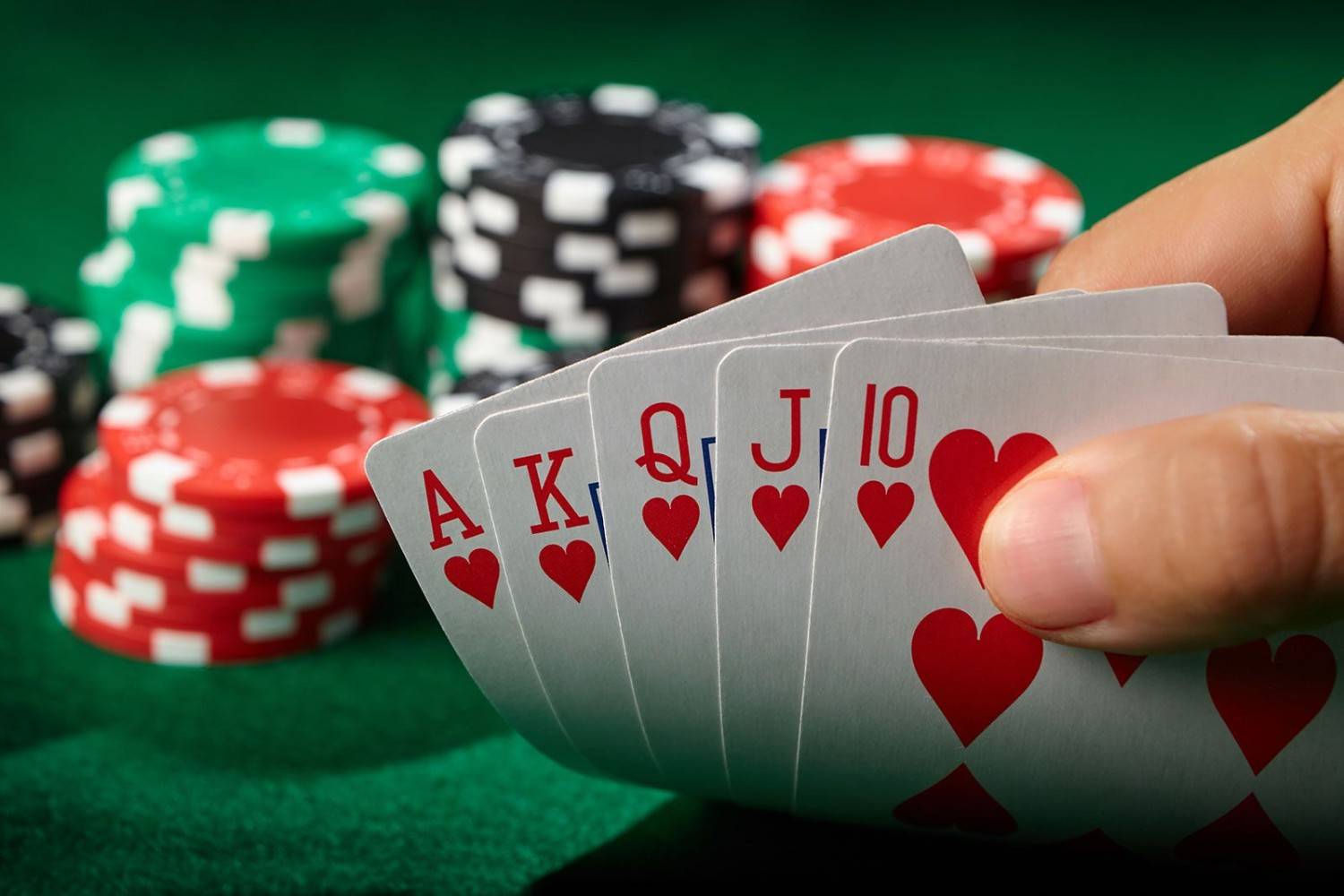
| 1 | Royal Flush | A♠ K♠ Q♠ J♠ 10♠ | 1 in 649,740 |
| 2 | Straight Flush | 7♥ 8♥ 9♥ 10♥ J♥ | 1 in 72,193 |
| 3 | Four of a Kind | 9♠ 9♥ 9♦ 9♣ K♠ | 1 in 4,165 |
| 4 | Full House | K♠ K♥ K♦ 7♣ 7♠ | 1 in 694 |
| 5 | Flush | A♦ J♦ 8♦ 5♦ 3♦ | 1 in 509 |
| 6 | Straight | 5♣ 6♦ 7♠ 8♥ 9♣ | 1 in 255 |
| 7 | Three of a Kind | Q♠ Q♥ Q♦ 9♣ 4♠ | 1 in 47 |
| 8 | Two Pair | J♠ J♥ 5♦ 5♣ A♠ | 1 in 21 |
| 9 | One Pair | A♠ A♥ K♦ 8♣ 3♠ | 1 in 2.4 |
| 10 | High Card | A♠ K♦ 9♣ 7♥ 2♠ | 1 in 2 |
If two players have the same hand type, the one with the higher cards wins. If they're identical, the pot is split.
Poker odds — the numbers behind every decision
Starting hand odds
Not all starting hands are created equal. The poker hand odds of being dealt specific holdings:
| Starting Hand | Probability | How Often |
|---|---|---|
| Any pocket pair (AA-22) | 5.9% | ~1 in 17 hands |
| Pocket Aces specifically | 0.45% | ~1 in 221 hands |
| Two suited cards | 23.5% | ~1 in 4.3 hands |
| AK (suited or unsuited) | 1.2% | ~1 in 83 hands |
Common post-flop odds
| Situation | Outs | Odds on Turn | Odds by River |
|---|---|---|---|
| Flush draw (4 to a flush) | 9 | 19.1% | 35.0% |
| Open-ended straight draw | 8 | 17.0% | 31.5% |
| Gutshot straight draw | 4 | 8.5% | 16.5% |
| Two overcards (need to pair one) | 6 | 12.8% | 24.1% |
| Set on the flop (pocket pair) | 2 | — | 11.8% |
The Rule of 2 and 4: A quick shortcut for estimating odds. Multiply your outs by 2 for the probability of hitting on the next card, or by 4 for the probability of hitting by the river. 9 outs × 4 = ~36% chance of completing a flush by the river (actual: 35.0%). It's not exact, but it's close enough for in-game decisions.
Our poker odds calculator gives precise probabilities for any hand matchup — enter your hole cards and the board to see your exact equity.
Pot odds — when to call and when to fold
Pot odds are the ratio of the current pot to the cost of calling. They tell you whether a call is mathematically profitable.
How pot odds work
The pot is £80. Your opponent bets £20. The pot is now £100, and you need to call £20.
Pot odds = £20 / (£100 + £20) = 16.7%
You need to win at least 16.7% of the time for a call to be profitable. If you have a flush draw (35% chance by the river), calling is clearly correct — your odds of winning exceed the price you're paying.
If you have a gutshot straight draw (16.5% by the river), it's borderline — the maths says call is roughly break-even.
Pot odds vs poker hand odds — the decision framework
| Your Draw | Outs | River Probability | Minimum Pot Odds Needed |
|---|---|---|---|
| Flush draw | 9 | 35.0% | Call if pot odds < 35% |
| Open-ended straight | 8 | 31.5% | Call if pot odds < 31.5% |
| Gutshot | 4 | 16.5% | Call if pot odds < 16.5% |
| Overcards | 6 | 24.1% | Call if pot odds < 24.1% |
If the pot odds are better (lower percentage) than your draw odds, call. If they're worse, fold. This single principle — comparing pot odds to hand odds — is the foundation of mathematically sound poker.
Beginner poker strategy
Starting hand selection — the most important skill
Most beginners play too many hands. In a full ring game (9-10 players), you should be folding roughly 70-80% of hands before the flop. Play only strong starting hands:
- Always play (raise with): AA, KK, QQ, JJ, AK suited, AK offsuit
- Usually play: 10-10, 99, AQ suited, AQ offsuit, AJ suited, KQ suited
- Sometimes play (depending on position): 88, 77, AT suited, KJ suited, QJ suited
- Fold everything else until you have more experience
Position — your biggest advantage
Your position relative to the dealer button determines when you act in each betting round. Acting last is a massive advantage — you see what everyone else does before you decide.
| Position | Where | Strategy |
|---|---|---|
| Early position (UTG) | First to act | Play only premium hands |
| Middle position | 4th-6th to act | Slightly wider range |
| Late position (Button, Cutoff) | Last to act | Widest range — information advantage |
| Blinds | Forced bet, act last pre-flop but first post-flop | Defend selectively |
Bet sizing
Pre-flop raise: 2.5-3× the big blind is standard. In a £1/£2 game, raise to £5-£6.
Post-flop bet: 50-75% of the pot. This prices out draws without risking too much.
Don't min-bet. Betting £2 into a £20 pot gives your opponent 11:1 odds to call — they should call with almost anything.
Poker vs casino gambling — a critical distinction
In casino games (roulette, blackjack, slots), you're playing against a fixed mathematical edge. The house always wins long-term. In poker, you're playing against other people — and the house takes a small rake (typically 2.5-5% of each pot, capped at £3-£5).
This means:
- Poker can be +EV for skilled players. If you consistently make better decisions than your opponents, you can profit long-term.
- But most players lose. The rake means the total money leaving the game exceeds the total money entering it. The rake is effectively the "house edge" of poker — and it means the average player loses. Only above-average players profit, and the rake ensures the bar is higher than "slightly above average."
- The skill element is real but overestimated by beginners. Most new players believe they're better than they are. Poker attracts competitive personalities who overrate their own ability — a pattern well-documented in the psychology of gambling. Honest self-assessment is the most valuable poker skill that nobody talks about.
Online poker in the UK
Online poker is legal and regulated in the UK under the Gambling Commission. Major sites include PokerStars, 888poker, partypoker, and GGPoker — all UKGC-licensed.
Key differences from live poker:
- Speed. Online deals 60-80 hands per hour vs 25-30 live. You're making decisions much faster, which amplifies both skill advantages and tilt-driven mistakes.
- Multi-tabling. Online lets you play 4-12+ tables simultaneously — increasing volume and potential earnings for winning players, but also increasing losses for losing players.
- Stakes. Online starts as low as £0.01/£0.02 blinds. Live typically starts at £1/£2. The low online stakes are ideal for learning.
- Tracking. Online poker software tracks every hand, making it possible to analyse your play in detail. Live poker relies on memory and note-taking.
Poker and responsible gambling
Poker's skill element creates a unique psychological trap: the belief that you're "due" to win because you're "better than these players." This is partly the gambler's fallacy (short-term results don't reflect long-term skill) and partly ego protection. Losing players rationalise losses as "bad luck" rather than examining their decisions.
If online poker has become a source of stress rather than enjoyment — if you're playing longer sessions to recover losses, moving up stakes beyond your bankroll, or neglecting other parts of your life — the skill element doesn't change the fact that it's become problematic. GamStop poker coverage includes all UKGC-licensed sites, and self-exclusion is available across all UK-regulated platforms.
For context on how poker fits into the broader UK gambling landscape and how much is spent across different products, see our UK gambling statistics.
Poker betting patterns — reading opponents
One of poker's most valuable skills is reading betting patterns — the information your opponents give you through how they bet.
| Pattern | What It Often Means |
|---|---|
| Bet-check-bet | Strong hand on flop, check to trap on turn, bet again on river |
| Check-raise | Trapping — they checked to let you bet, then raised with a strong hand |
| Min-bet | Often weakness — they want to see the next card cheaply |
| Overbet (2×+ the pot) | Polarised — either very strong or a bluff |
| Instant call | Drawing hand — made the decision before you bet |
| Long pause then raise | Often genuine strength — they were deciding how much to raise |
These are generalisations, not rules. Good players deliberately vary their betting patterns to be unpredictable. But at low stakes, most opponents are predictable — their betting patterns are reliable tells. For more on the numbers behind every gambling decision, see 5 numbers every gambler should check.
Frequently asked questions
Written by
David Burke
David is a gambling industry analyst and poker player based between London, Spain, and Malta. He has spent over a decade observing the European betting and casino landscape, with particular expertise in odds, probability, game strategy, and how the bookmaking industry works. At WiseStaker, David writes guides on bet types, game rules, and the mathematics behind gambling.
Follow on X →